The Night They Chose to Save the World Instead of Themselves
The hospital hallways were silent that night, but it was not the silence of rest.
It was the silence of exhaustion—the kind that settles only after a long battle fought with empty stomachs, trembling hands, and hearts that refuse to give up.
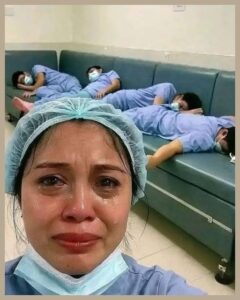
Maria stood in the corner of the break room, her mask pulled down, her breath uneven, and her eyes burning with tears she had tried to hide all shift long. She had promised herself she wouldn’t cry today—not again. But as she looked over at her colleagues collapsed on the cold hospital couches, still wearing their scrubs, still holding onto the last bit of strength they had, something inside her broke.
They weren’t sleeping.
They were recovering… just enough to stand up and fight the next round.
It had been 19 hours since their shift began.
19 hours of running from room to room.
19 hours of watching oxygen levels drop and alarms scream.
19 hours of reminding frightened families that they were doing everything possible.
19 hours of watching lives slip away despite their desperate efforts.
Maria had held five hands that day as their owners took their final breath—because no family members were allowed inside. She had whispered prayers for strangers, whispered apologies when she couldn’t save them, whispered comfort to soothe their fear.
She had promised every single one of them that they were not dying alone.
Her uniform was still damp from the moments when she had leaned over a patient’s bed, crying silently behind her fogged-up face shield. But she didn’t stop. None of them did.
When the shift “ended,” no one had the strength to walk home.
No one had the energy to talk.
No one had the power to even remove their masks.
They simply collapsed—together—where they stood.
Maria looked at their faces:
Ana, who hadn’t seen her children for three weeks because she was afraid of infecting them.
Jae, who had worked through his own fever because the hospital was understaffed.
Luis, who lost his father two days earlier but refused to take time off because “my patients need me too.”
And the youngest among them, barely out of school, trembling every time a patient’s condition worsened—but showing up, every shift, anyway.
Maria’s tears finally spilled over.
Not because she was weak.
But because she was human.
She pulled out her phone, intending only to capture this moment for herself—this moment that represented the courage, the sacrifice, the pain, and the invisible heroism that the world would never truly understand.
But her hand shook as she held the phone.
She looked into the camera, tears running down her cheeks, her mask hanging loose, her eyes red from the weight of a thousand unspoken emotions.
Behind her, her team lay like fallen soldiers.
This was not just exhaustion.
It was devotion.
It was love.
It was the price of saving lives.
People would never know that on nights like these, they cried quietly in storage rooms, ate meals standing up, skipped water so they wouldn’t have to remove their masks, and whispered to themselves:
“Just one more patient… just one more.”
And so Maria took the photo—
not to show suffering,
but to show the world what real heroes look like.
Not capes.
Just scrubs.
Not powers.
Just hearts that refuse to stop caring.
When she finally lay beside her colleagues, she whispered into the dim room:
“We did our best today. Tomorrow… we try again.”
And in that moment, with tears drying on her face, surrounded by people who had given everything they had and more, Maria realized something:
Heroes don’t always rise.
Sometimes… they collapse.
But even on the floor, they shine.
And the world never stops surviving because of them.