Kyle Maynard Lost His First 35 Wrestling Matches—Then He Climbed Kilimanjaro Without Prosthetics
Kyle Maynard lost his first 35 wrestling matches.
Years later, he crawled to the summit of Africa’s highest mountain.
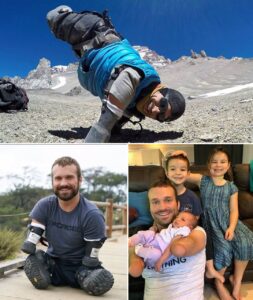
Born with congenital amputation, Kyle grew up with arms ending near his elbows and legs ending near his knees. But from an early age, his parents encouraged him to become as independent as possible and to find his own ways of doing things.
That mindset would eventually take him far beyond the wrestling mat.
It would take him up Mount Kilimanjaro.
A Different Way of Doing Things
Kyle didn’t grow up waiting for the world to become easier for him.
He played football.
He wrestled.
He lifted weights.
He later competed in mixed martial arts and Brazilian jiu-jitsu.
Instead of relying on traditional approaches, he adapted movements and equipment to the body he had.
That approach became one of the defining themes of his life: when something seemed difficult or unfamiliar, the question wasn’t necessarily whether he could do it the conventional way.
It was how he could find another way.
Losing 35 Wrestling Matches
When Kyle decided he wanted to wrestle as a teenager, the beginning was brutal.
He lost 35 consecutive matches during his first season.
But he didn’t quit.
His goal eventually shifted from winning to simply finding ways to avoid being pinned.
Then something changed.
He kept wrestling.
By his senior year, Kyle had won 36 varsity matches, defeated accomplished wrestlers and eventually became a nationally ranked competitor.
The same athlete who had started his wrestling career with 35 straight defeats had transformed himself into a highly accomplished wrestler.
But his biggest physical challenge was still ahead.
The Mountain: Mount Kilimanjaro
Kyle eventually decided to attempt something that would require him to completely rethink how a person climbs a mountain.
Mount Kilimanjaro.
At 5,895 meters, Kilimanjaro is the highest mountain in Africa.
Kyle wasn’t going to walk up it.
He planned to bear crawl his way to the summit without prosthetic limbs.
The preparation was anything but ordinary.
Early experiments included pieces of mountain-bike tires and heavy-duty tape to protect the ends of his limbs. Eventually, specialists helped create custom equipment designed specifically for the climb.
Every part of the journey had to be adapted.
Ten Days of Crawling Toward the Summit
In January 2012, Kyle began the climb.
For hours each day, he moved across rock, dirt and increasingly challenging terrain using a bear-crawl technique.
It was physically demanding and required constant protection for his limbs.
After 10 days, Kyle reached Uhuru Peak.
He had become the first quadruple amputee to reach the summit of Mount Kilimanjaro without the aid of prosthetics.
The achievement was extraordinary.
But the expedition was about more than reaching a mountain summit.
Mission Kilimanjaro Was Bigger Than the Mountain
The expedition, known as Mission Kilimanjaro, included wounded and recovering U.S. military veterans and was designed to raise awareness and support for people living with disabilities.
The team also visited the Mwereni Integrated School for the Blind in Tanzania and delivered $25,000 worth of medical supplies to the school.
Kyle also carried something deeply personal to the summit.
At the request of the family of fallen U.S. soldier Pfc. John Corey Johnson, he carried Johnson’s ashes to the top of Kilimanjaro.
So when Kyle finally reached the summit, he wasn’t climbing only for himself.
He was carrying the stories and hopes of other people with him.
Kilimanjaro Wasn’t the End
For many people, reaching Kilimanjaro’s summit would have been the ultimate challenge.
Kyle wasn’t finished.
In 2016, he reached the summit of Mount Aconcagua in Argentina, the highest mountain outside Asia, again without prosthetics.
By then, his life had become a remarkable collection of achievements across wrestling, martial arts, mountaineering and other physical challenges.
But perhaps the most revealing part of his story still goes back to those first 35 wrestling matches.
The Lesson Behind the 35 Losses
Losing once can be discouraging.
Losing five times can make you question yourself.
Losing 35 times in a row could make almost anyone wonder whether they should stop.
Kyle kept going.
His story shows that progress doesn’t always begin with success. Sometimes it begins with continuing after failure has already given you plenty of reasons to quit.
His parents had encouraged him from childhood to figure out how to do things independently rather than automatically doing everything for him.
That philosophy stayed with him.
Years later, when he faced mountains that appeared almost impossible, he approached them with the same basic question:
How can I do it?
Not necessarily the way everyone else does it.
Not necessarily with the same equipment.
Not necessarily by following the usual path.
But by finding a way that works.
And sometimes, finding that way takes 35 losses before the first victory.
Kyle Maynard’s story isn’t just about climbing mountains. It’s about refusing to let the first failure decide where the journey ends. ❤️