Noah’s Ark Mystery
High in the mountains of eastern Turkey, near Mount Ararat, sits one of the world’s most mysterious geological formations.
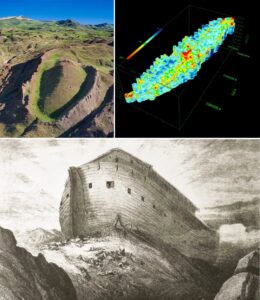
From above, it looks remarkably like an enormous ship.
For more than six decades, that unusual shape has fueled a remarkable question: Could this really be the remains of Noah’s Ark?
Now, new subsurface scans and drilling have brought the formation back into the spotlight — while also raising questions that researchers say can only be answered through further physical evidence.
A Formation That Looks Like a Giant Ship
The formation is known as the Durupınar Formation, located in Turkey’s Ağrı Province near Mount Ararat.
It stretches approximately 157 meters from end to end, giving it an unusual similarity to the dimensions traditionally associated with Noah’s Ark.
The Book of Genesis describes the Ark as being 300 cubits long. Depending on the length assigned to the ancient cubit, that measurement is often estimated at roughly 135–157 meters.
That apparent connection has fascinated researchers and Ark enthusiasts for decades.
The formation first attracted widespread attention after it was identified in aerial photographs in 1959.
Since then, some researchers have argued that the unusual structure could represent the remains of the biblical vessel.
But there is a major problem.
Geologists Have a Very Different Explanation
Not everyone sees a ship beneath the Turkish landscape.
Geological studies have argued that the distinctive boat-like shape can be explained through entirely natural processes.
Rock deformation, erosion, landslides and the region’s complex geological history can create formations that appear surprisingly artificial when viewed from above.
In other words, looking like a ship does not necessarily mean that something man-made is buried underneath.
That debate has continued for generations.
But newer technology has now given researchers another way to investigate the mystery.
New Scans Reveal Strange Subsurface Patterns
In 2026, researchers involved in the investigation returned to the Durupınar site with modern scanning techniques.
According to the research team, subsurface imaging revealed several unusual features beneath the formation.
Among the reported findings are straight-looking structures, apparent right-angle intersections and large cavity-like spaces at different depths.
Researchers have suggested that some of these patterns could resemble chambers or corridors.
One deeper layer has also reportedly been interpreted as having three distinct sections.
That detail has attracted particular attention because the biblical account describes Noah’s Ark as having three decks.
But there is an important distinction between finding an unusual geological pattern and proving that it was constructed by humans.
The scans alone cannot establish that.
Then Researchers Began Drilling
Perhaps the most interesting development is that the investigation has moved beyond aerial photographs and underground imaging.
Researchers have reportedly taken physical core samples from the formation.
One sample is said to contain material with organic components, which is now being examined to determine exactly what it is.
That could potentially provide more useful evidence than simply observing the formation’s shape.
But organic material by itself would not automatically prove the existence of Noah’s Ark.
Natural geological formations can contain organic material, and researchers would need to establish its origin, age and relationship to the surrounding structure.
Has Noah’s Ark Been Found?
No — not scientifically.
Despite increasingly dramatic headlines online, the Durupınar Formation has not been established as Noah’s Ark.
Even researchers who support the possibility have emphasized that it is too early to make that claim.
The key question is not whether the formation resembles a ship.
It clearly does.
The real question is whether the structures beneath it can be demonstrated to be human-made and whether any recovered material can be reliably connected to an ancient vessel.
That is a much higher scientific standard.
Why the Mystery Continues
The Durupınar Formation remains fascinating precisely because both possibilities have to be considered.
On one side, there is an extraordinary ship-shaped formation with dimensions that have long attracted comparisons to the biblical description of the Ark.
On the other, there are geological explanations that can account for the formation through natural processes.
The new scans do not settle that debate.
Instead, they add another layer to it.
If further drilling eventually uncovered unmistakably worked timber, human-made structures or other evidence that could not reasonably be explained by geology, the discovery would demand enormous scientific attention.
Until then, the formation remains an intriguing archaeological and geological mystery.
A Question That Has Survived for More Than 60 Years
For generations, people have looked at the mountains near Mount Ararat and wondered whether something extraordinary might be hidden beneath the surface.
Now researchers are attempting to replace speculation with physical evidence.
The Durupınar Formation is still a 157-meter-long geological mystery.
There are reported structures beneath the surface.
There are new samples being analyzed.
And there is still no scientific confirmation that Noah’s Ark has been discovered.
Perhaps future drilling will finally provide an answer.
Or perhaps the deeper researchers look, the more clearly the formation’s natural geological history will emerge.
Either outcome would make the decades-old mystery worth investigating.
For now, one enormous question remains:
What is really buried beneath Turkey’s giant ship-shaped formation?