Robert Hoge: The Boy Who Chose His Own Face and Refused to Let “Ugly” Define Him
When Robert Hoge was born in Brisbane, Australia, in 1972, his family was confronted with something they had never expected.
Robert had a large tumor growing from the center of his face. It had pushed his eyes toward the sides of his head, and his legs were severely deformed.
His mother, Mary, was overwhelmed.
For several days after his birth, she struggled to look at her newborn son.
Years later, Robert would read the diary she had kept during that time and discover just how frightened and uncertain she had been.
But that wasn’t where Robert’s story ended.
It was where it began.
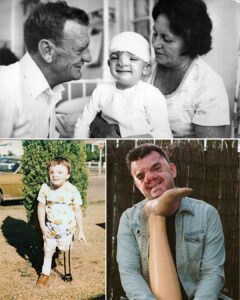
A Family Faced With an Impossible Decision
Robert’s condition was so severe that his mother initially told hospital staff she didn’t know if she could take him home.
At one point, doctors even suggested that the family consider institutional care.
Then something extraordinary happened.
Robert’s brothers and sisters were asked whether they wanted their baby brother to come home with the family.
Their answer was immediate.
They wanted him.
No hesitation.
That decision changed the course of Robert’s life.
Instead of growing up separated from his family, Robert went home and began a childhood that would involve years of medical treatment.
A Childhood Defined by Hospitals and Surgeries
Doctors removed the tumor and performed reconstructive operations to help Robert breathe, see and function more easily.
His legs were eventually amputated because of their severe deformities, and he learned to live with prosthetic limbs.
By the age of 14, Robert had already undergone approximately 24 surgeries.
But one operation would force him to make a decision that was unlike any previous medical choice.
This time, the decision was going to be his.
The Surgery That Could Change His Face
Doctors offered Robert another major facial operation.
The procedure could alter his appearance and move his eyes closer together.
But there was a serious risk.
Robert could lose his eyesight.
For the first time, his parents didn’t simply make the decision for him.
They gave their teenage son the choice.
Robert’s family discussed the possibilities together.
Then his brother Michael reportedly asked a question that changed the way Robert looked at the decision:
What was the point of looking better if Robert couldn’t see himself?
For Robert, the answer became clear.
He refused the surgery.
He chose to keep his face as it was.
Choosing His Face Didn’t Make Life Easy
That decision didn’t suddenly make Robert’s teenage years easy.
He still experienced staring, rejection and cruel comments about his appearance.
People noticed that he looked different.
And sometimes, they weren’t kind about it.
But Robert gradually began to change his relationship with the word “ugly.”
Instead of allowing other people’s judgments to define him, he began confronting the subject directly.
He didn’t pretend that physical appearance didn’t matter.
He acknowledged something much more uncomfortable:
People notice differences.
They always have.
The question is what they decide those differences mean.
From the Boy in the Hospital to a Writer and Father
Robert eventually built a life that extended far beyond his medical history.
He became a journalist, worked in politics, married and became a father.
He later wrote his memoir, Ugly, in which he openly explored his childhood, his appearance, his family and the way society treats people who look different.
The title itself was deliberately provocative.
Rather than hiding from the word, Robert examined what it actually means and why society gives physical appearance so much power.
One of the lines associated with his writing captures the idea:
“If I’m not ugly, no one is.”
His argument isn’t simply that appearance doesn’t matter.
It’s that pretending people don’t notice visible differences can sometimes be less honest than acknowledging them and understanding that a person’s appearance does not determine their worth.
The Decision He Made at 14
Looking back, one of the most important moments in Robert’s story happened when he was just 14.
He was given the opportunity to change his face.
But changing his face came with the possibility of losing his sight.
Robert chose otherwise.
He chose to keep the face he had.
That decision didn’t erase the challenges that came with being visibly different. But it gave him something important: ownership over his own appearance and, eventually, over the story he told about it.
The little boy who had once been viewed through the lens of his medical condition became a journalist, author, husband and father.
His face was only one part of his story.
What Robert Hoge’s Story Really Asks Us
Robert’s story raises a difficult question about acceptance.
Is acceptance pretending not to notice that someone looks different?
Or is it being able to notice the difference without allowing it to determine how you value that person?
Robert’s life suggests that the second question may be worth considering.
A face can be different.
A body can be different.
People may stare.
But none of those things can tell you everything about the person standing in front of you.
At 14, Robert chose the face he already had.
Decades later, he turned that choice into a story about identity, appearance and learning to live without letting other people’s definitions become your own.
And perhaps that is why his story continues to resonate.
He didn’t need the world to stop seeing his difference. He needed the world to understand that his difference was never the whole of him. ❤️